
Imagine a vast ocean, yet only a small fraction of it is visible to you. The rest remains shrouded in an impenetrable mist, its depths unknown. This analogy aptly describes our current understanding of the cosmos. For all the galaxies, stars, and planets we can see, they make up less than 5% of the universe's total mass-energy. The remaining 95% is a profound mystery, dominated by what scientists call dark matter and dark energy.
The Universe's Greatest Mystery: Dark Matter
What is Dark Matter?
The concept of dark matter isn't new; it has been around for nearly a century. First hinted at by astronomer Jan Oort in the 1930s and later championed by Vera Rubin in the 1970s, dark matter is the gravitational glue that holds galaxies together. We can't see it, it doesn't emit or absorb light, and it doesn't interact with the electromagnetic force in any way we currently understand. Yet, its gravitational influence is undeniable. Galaxies spin faster than they should, galactic clusters are far more massive than their visible components suggest, and the large-scale structure of the universe points unequivocally to its overwhelming presence.
Despite this compelling evidence, what dark matter *is* remains one of the most significant unanswered questions in modern physics. The particles we know and love - protons, neutrons, electrons, photons - are all part of the Standard Model of particle physics, and none of them fit the bill for dark matter.
The Limitations of the Standard Model
The Standard Model is a triumph of human intellect, successfully describing the fundamental particles and forces (strong, weak, and electromagnetic) that govern our visible universe. However, it's incomplete. It doesn't include gravity, it doesn't explain neutrino masses, and most crucially for our discussion, it offers no candidate for dark matter. This incompleteness suggests that there might be an entirely "dark sector" of particles and forces, operating alongside our known universe but largely hidden from our direct observations.
This is where the intriguing idea of a dark photon enters the picture.
Introducing the Dark Photon: A New Messenger
Analogy with the Familiar Photon
To understand a dark photon, let's first consider its familiar cousin: the ordinary photon. Photons are the quantum particles of light, the carriers of the electromagnetic force. They allow us to see, communicate via radio waves, heat food in microwaves, and even get a tan from UV radiation. They are massless, travel at the speed of light, and interact with anything that has an electric charge.
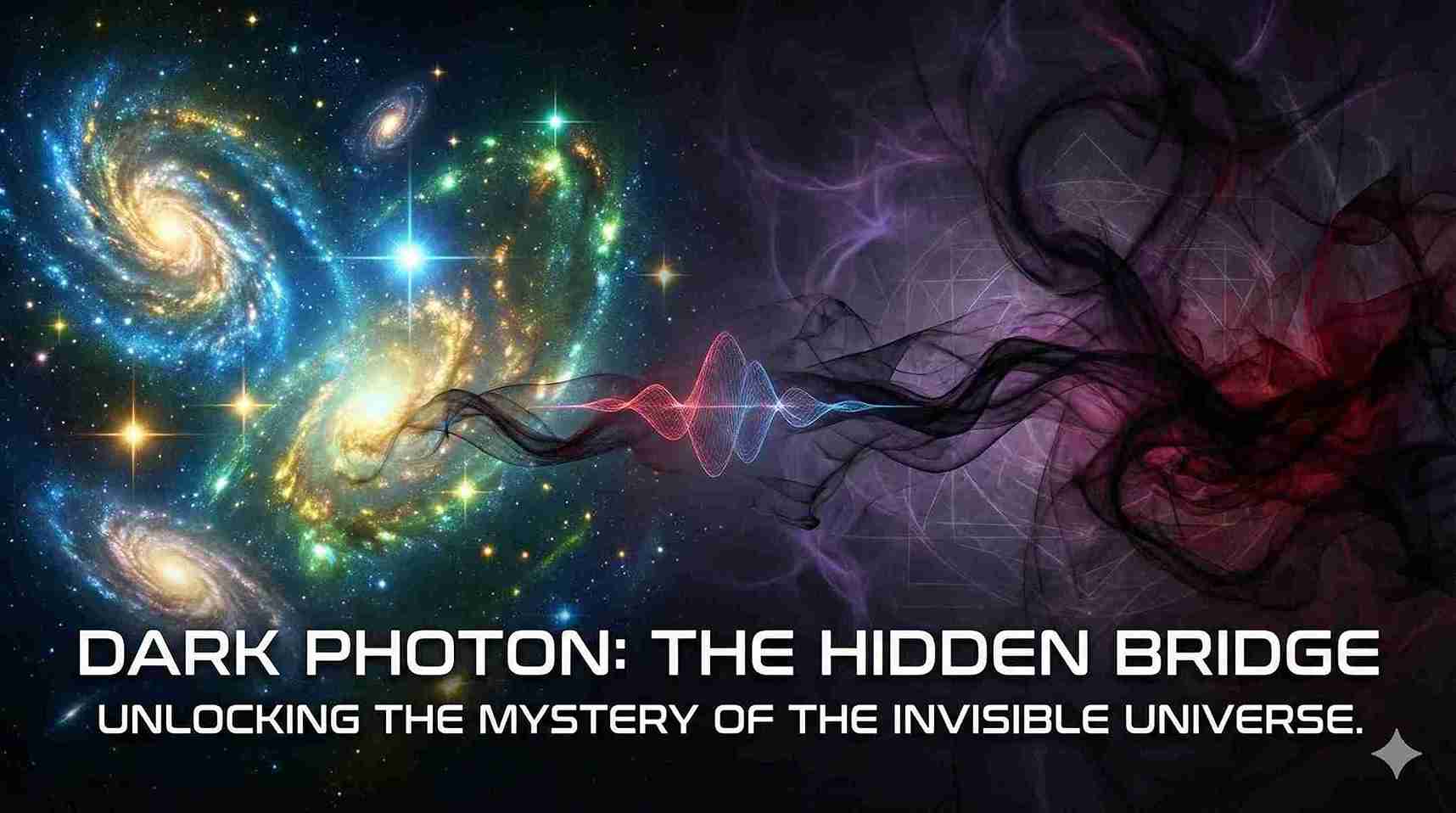
Now, imagine a parallel universe, existing in the same space as ours but interacting only very weakly with it. In this 'dark sector', there might be dark matter particles. Just as our visible particles interact via ordinary photons, perhaps dark matter particles interact via their own 'dark' force, carried by a 'dark light' particle: the dark photon.
The Hypothesized Role of Dark Photons
The dark photon (often denoted as A') is a hypothetical elementary particle that would be analogous to the ordinary photon but would primarily interact with dark matter particles. While our photons mediate electromagnetic interactions between charged particles, dark photons would mediate interactions between dark matter particles, or perhaps even act as a subtle bridge between the dark sector and our visible matter.
Unlike ordinary photons, dark photons are often theorized to have a small, but non-zero, mass. This mass is a crucial distinction, as it would allow for different interaction dynamics. They would also interact extremely weakly with ordinary matter, which is why we haven't detected them yet. This weak interaction is key to understanding their potential to explain dark matter phenomena without being easily observed.
Scientists postulate that if dark photons exist, they could:
- Explain certain anomalies in astrophysical observations, such as unexpected gamma-ray signals from the galactic center.
- Provide a mechanism for dark matter to "feel" a force, giving it internal structure or allowing it to annihilate into other dark sector particles.
- Offer a "portal" between our visible universe and the dark sector, allowing for minuscule interactions that could eventually be detected.
The Hunt for the Invisible: How Scientists Search for Dark Photons
The search for dark photons is a frontier in particle physics, pushing the boundaries of experimental design and sensitivity. Given their hypothesized weak interactions with ordinary matter, detecting them is an enormous challenge, requiring ingenious approaches.
Experimental Approaches: From Accelerators to Detectors
- "Light Shining Through Walls" Experiments: These experiments involve a powerful laser beam directed at a thick, opaque barrier. If dark photons exist, some ordinary photons could theoretically oscillate into dark photons, pass through the wall (since dark photons don't interact with ordinary matter like the wall does), and then oscillate back into ordinary photons on the other side, where they could be detected. These are often called "photon regeneration" experiments.
- High-Energy Particle Colliders: Facilities like the Large Hadron Collider (LHC) at CERN are powerful tools for probing new physics. Scientists look for "missing energy" signatures in particle collisions. If dark photons are produced, they would carry away energy without being directly detected, leaving an imbalance in the energy conservation equations. Additionally, researchers might look for exotic decays of known particles that could produce dark photons, or for dark photons decaying into pairs of ordinary particles (like electrons and positrons) with very specific, unusual characteristics.
- Astrophysical Observations: Telescopes and observatories can also be used to search for indirect evidence. If dark matter particles interact via dark photons and annihilate, they might produce faint signals (like gamma rays or X-rays) that are slightly different from what standard astrophysical processes predict. Anomalies in cosmic microwave background radiation or the distribution of dark matter in galaxies could also hint at dark photon interactions.
- Precision Measurements: Extremely sensitive experiments designed to measure fundamental constants or subtle electromagnetic effects can also probe for dark photons. For instance, tiny deviations in the gravitational inverse square law or electron g-2 measurements (a property of electrons) could indicate the presence of a weakly interacting dark photon.
What Would a Discovery Mean?
Detecting a dark photon would be nothing short of revolutionary. It would provide the first direct window into the dark sector, confirming that our universe is far richer and more complex than the Standard Model currently describes. Such a discovery would not only illuminate the nature of dark matter but also potentially open up entirely new fields of physics, expanding our understanding of fundamental forces and particles.
Potential Impact and Future Prospects
Rethinking Our Understanding of the Cosmos
The existence of a dark photon would profoundly impact our cosmological models. It could offer new explanations for how galaxies form and evolve, influence the dynamics of dark matter halos, and even shed light on the universe's earliest moments. If dark photons are indeed the 'glue' for dark matter, they might explain why dark matter behaves in certain ways that are currently puzzling, such as the observed distribution of dark matter in dwarf galaxies.
Moreover, a dark photon could be a stepping stone to understanding dark energy, the mysterious force accelerating the universe's expansion. While not directly linked, both represent fundamental unknowns that push the boundaries of current physics.
The Future of Dark Matter Research
The search for dark photons represents a vibrant and exciting direction for dark matter research. With ongoing and planned experiments constantly improving their sensitivity, the possibility of uncovering these hidden messengers is growing. Breakthroughs in detector technology and theoretical advancements continue to refine the hunt, making it an exhilarating time for particle physics and cosmology.
Conclusion: Peering into the Shadowy Realm
The quest for the dark photon is more than just a search for another particle; it's a profound exploration into the very fabric of reality. It's an attempt to complete our cosmic picture, to understand the vast, unseen majority of our universe. Whether they manifest as subtle ripples in spacetime or as direct hits in our detectors, dark photons represent a tantalizing possibility: a bridge to the universe's deepest secrets.
As scientists continue to shine their metaphorical light into the darkness, the hope remains that one day, these elusive messengers will reveal themselves, ushering in a new era of physics and fundamentally changing our understanding of everything.