

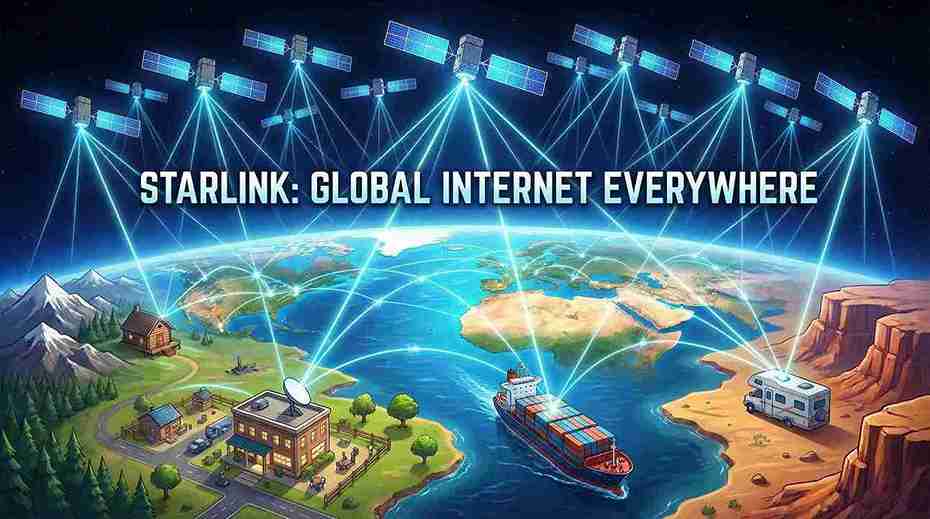
In an increasingly connected world, access to reliable, high-speed internet is no longer a luxury but a fundamental necessity. Yet, vast swathes of the globe, particularly rural and remote areas, remain underserved or completely disconnected. Enter Starlink satellites, a revolutionary initiative by SpaceX, poised to fundamentally reshape the landscape of global connectivity. By deploying a vast constellation of satellites in low-earth orbit internet, Starlink promises to deliver performance that was once unthinkable for satellite internet, offering a lifeline to businesses, communities, and individuals worldwide.
This deep dive will explore the technology behind SpaceX Starlink, its impressive capabilities, its cost implications, and crucially, its transformative potential for businesses across various sectors. We'll examine how this innovative solution is helping to bridge the digital divide, the practicalities of Starlink for business and for specialized uses like Starlink for RVs, and what the future holds for this pioneering venture in global internet access.
The Dawn of Satellite Internet: A New Era
What Are Starlink Satellites?
At its core, Starlink is a satellite internet constellation operated by SpaceX, designed to provide high-speed, low-latency internet access to virtually any location on Earth. Unlike traditional satellite internet providers that rely on a few large, geostationary satellites orbiting at approximately 35,786 kilometers (22,236 miles) above the equator, Starlink employs thousands of smaller, mass-produced satellites. These satellites are launched in batches by SpaceX's Falcon 9 rockets, building a rapidly expanding network in space.
The Low-Earth Orbit Advantage
The key to Starlink's groundbreaking performance lies in its strategic placement in low-earth orbit (LEO). Starlink satellites orbit at altitudes typically between 340 to 550 kilometers (210 to 340 miles). This significantly shorter distance to Earth compared to geostationary satellites dramatically reduces the signal travel time, also known as latency. Lower latency translates directly into a more responsive internet experience, making activities like video conferencing, online gaming, and real-time data transfer far more feasible and enjoyable than with traditional satellite services. Furthermore, the sheer number of satellites in the constellation ensures a continuous, widespread coverage area.
Unpacking Starlink's Performance and Accessibility
Starlink Speeds and Latency: A Game Changer?
For many years, satellite broadband was synonymous with slow speeds and high latency, making it a last resort for internet access. Starlink fundamentally alters this perception. Users commonly report Starlink speeds ranging from 50 to 200 Mbps (megabits per second) for downloads, with some reaching even higher, and upload speeds typically between 10 to 20 Mbps. Latency often sits in the 20-40ms (milliseconds) range, comparable to many terrestrial broadband connections. This level of performance is a genuine game-changer, especially for areas where traditional wired or fiber optic internet simply isn't available.
Starlink Cost: Investment vs. Value
While Starlink offers unparalleled access, understanding Starlink cost is crucial. The investment typically involves a one-time purchase of the Starlink hardware (Dishy McFlatface, Wi-Fi router, power supply, and cables), which can be several hundred dollars. Following this, there's a recurring monthly subscription fee. While these costs might be higher than some urban terrestrial broadband plans, for individuals and businesses in areas lacking viable alternatives, the value proposition of high-speed, reliable internet often outweighs the initial outlay. SpaceX continually adjusts pricing and introduces new tiers (like Starlink Business, RV, and Maritime), reflecting market demands and operational costs.
Bridging the Digital Divide: Rural Broadband and Beyond
The profound impact of Starlink on rural broadband cannot be overstated. For millions of people and businesses worldwide, inadequate internet infrastructure has severely limited opportunities for education, economic growth, and social connection. Starlink provides a viable, high-performance solution where fiber optics are too expensive to lay and cellular networks lack coverage. By making fast internet accessible in previously unserved regions, Starlink is actively contributing to narrowing the digital divide, empowering communities and fostering global inclusivity.
Starlink's Transformative Impact on Business
The implications of readily available high-speed internet in remote locations are particularly significant for businesses. Starlink for business opens up a world of possibilities:
Remote Work and Decentralized Operations
With reliable connectivity, companies can confidently hire talent from anywhere, supporting robust remote work models and decentralizing operations without sacrificing productivity. This allows businesses to tap into broader talent pools and reduce overheads associated with large physical offices.
IoT, Agriculture, and Maritime Applications
Industries traditionally limited by connectivity can now thrive. Remote agricultural operations can deploy IoT sensors for precision farming, monitoring crops and livestock in real-time. Mining and construction sites in isolated areas can maintain seamless communication and data transfer. Furthermore, global internet access via Starlink is revolutionizing maritime industries, offering high-speed connectivity to vessels far out at sea, improving logistics, crew welfare, and operational efficiency.
Disaster Recovery and Emergency Services
In times of natural disaster or emergency, traditional communication infrastructure can be compromised. Starlink's independent network provides a crucial backup, enabling emergency services, NGOs, and government agencies to quickly establish communication links in affected areas, facilitating aid and recovery efforts.
Starlink for Every User: RVs, Maritime, and More
Beyond traditional fixed locations, Starlink has expanded its offerings to cater to dynamic needs. Starlink for RVs (now Starlink Roam) allows users to take their high-speed internet with them on the go, making remote travel and digital nomadism more practical than ever. Similarly, Starlink Maritime delivers robust connectivity to ships, yachts, and offshore platforms, bringing the benefits of high-speed internet to the world's oceans. These specialized services underscore Starlink's versatility and its ambition for truly ubiquitous global internet access.
The Competitive Landscape: Project Kuiper and OneWeb
While Starlink is a prominent player, it's not alone in the LEO satellite internet race. Competitors like Amazon's Project Kuiper and Eutelsat OneWeb (formerly just OneWeb) are also developing their own constellations. Project Kuiper aims to deploy over 3,200 satellites, promising similar high-speed, low-latency services. OneWeb, already partially operational, focuses more on enterprise and government clients. This emerging competition is healthy, driving innovation, improving service quality, and potentially reducing costs for consumers and businesses alike in the long run.
The Future of Global Connectivity: Challenges and Opportunities
The future of satellite broadband looks incredibly bright, largely thanks to Starlink. However, challenges remain. The sheer number of satellites raises concerns about space debris and light pollution for astronomers. Regulatory hurdles and international agreements for spectrum use and orbital slots are ongoing complexities. Nevertheless, the opportunities far outweigh the challenges. Starlink is accelerating the democratization of internet access, fostering economic development in underserved regions, and enabling new technological advancements that rely on widespread, high-performance connectivity. As the constellation grows and technology evolves, Starlink's role in shaping our connected future will only become more profound.
In conclusion, Starlink satellites represent a monumental leap forward in global internet access. By harnessing the power of low-earth orbit, SpaceX has not only created a formidable solution for rural broadband but has also unlocked unprecedented potential for businesses, from enabling remote operations to revolutionizing industry-specific applications. The ongoing expansion and the emerging competitive landscape promise a future where high-speed internet is no longer a privilege of geography but a universal utility, accessible to everyone, everywhere.